Never Attempt a DIY Microwave Repair
Do not open a microwave's outer cabinet to repair it yourself: the high-voltage parts inside can deliver a fatal shock, and the U.S. Consumer Product Safety Commission (CPSC) warns that a shock is still possible after the oven is unplugged. What you can do safely is rule out a handful of simple causes from the outside, then hand anything deeper to a technician or replace the unit.
Why is microwave repair dangerous even when it is unplugged?
Most appliances are reasonably safe to open once the power is off. Microwaves are the exception. The CPSC publishes a specific warning against do-it-yourself microwave repair, noting that microwaves use high voltage, that the possibility of electrical shock exists even after the oven is disconnected, and that "should certain internal devices fail, even unplugged ovens can cause serious injury." The same notice, last revised in 2012, reports an average of two electrocution deaths a year from 2006 through 2008 linked to consumers attempting microwave repairs.
The reason is stored energy. Manufacturers' own service documents, written for trained technicians only, treat the high-voltage section as dangerous until it has been deliberately discharged. Whirlpool's technician sheet for an over-the-range microwave warns that high voltage is present at the magnetron and high-voltage capacitor terminals and tells technicians to make sure the capacitor is discharged before touching those components. GE's technical service manual explains that the capacitor has an internal resistor meant to drain it automatically, yet still instructs technicians to verify it is discharged before any service. If that resistor or another part has failed, the charge can remain.
What is inside the high-voltage section?
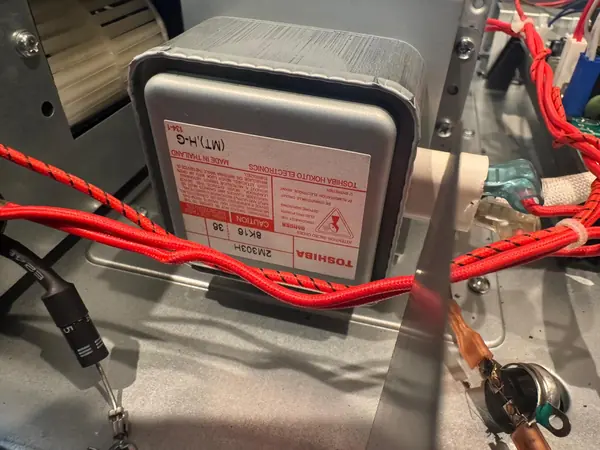
Behind the control panel and the outer cover sit the parts that make a microwave work and make it hazardous:
| Part | What it does | Why it is not DIY |
|---|---|---|
| High-voltage transformer | Steps household current up to a much higher voltage | Carries lethal voltage whenever the oven runs |
| High-voltage capacitor | Stores energy for the magnetron circuit | Can hold a charge after the plug is pulled if a part has failed |
| High-voltage diode | Works with the capacitor to feed the magnetron | Part of the same high-voltage circuit |
| Magnetron | Produces the microwaves that heat food | Live at high voltage in operation; also the source of microwave energy |
| Door interlock switches | Shut off microwave production when the door opens | Wrong parts or wiring can defeat a safety system |
Inverter models replace the transformer, capacitor and diode with a high-voltage inverter board, which is just as dangerous to touch.
Testing any of these requires discharging the capacitor with proper tools and a meter rated for the job. That is technician work, not a weekend project.
Why are door and interlock repairs off-limits?
The door is a safety system, not just a lid. The FDA has regulated the manufacture of microwave ovens since 1971. Its federal standard limits microwave leakage, over the oven's lifetime, to 5 milliwatts per square centimeter at about 2 inches from the oven surface, and it requires every oven to have two independent interlock systems that stop microwave production the moment the latch is released or the door opens.
A bent door, a broken hinge or a substitute latch switch can undermine that protection. The FDA advises against using an oven if the door does not close firmly or is bent, warped or otherwise damaged, and says to contact the manufacturer if the hinges, latches or seals are damaged.
What can you safely check yourself?
These checks do not involve removing any cover, and they solve a surprising share of "dead" or "not heating" complaints. Work through them in order:
- Power at the outlet. Plug a small appliance you know works into the same outlet. Whirlpool says the microwave should be plugged directly into a working wall outlet.
- The breaker or fuse. Check the panel for a tripped breaker or blown fuse. For an over-the-range model, Whirlpool suggests switching the breaker off for one minute, then back on, as a power reset.
- The door closes fully. Samsung notes that if the door is not completely shut, the microwave may run but will not heat. Wipe the door edge and frame with a damp cloth to remove food buildup, and listen for a clean latch.
- The turntable. If the plate does not spin, Whirlpool says to confirm the turntable is right side up and sitting securely on its support. Do not run the oven without the turntable in place.
- Control lock. A locked keypad looks like a dead microwave. On many GE models, pressing and holding Clear/Off or Pause/Off for about three seconds turns the lock on or off; other brands use a different key, so check your manual.
- Demo mode. Samsung explains that in Demo mode every function appears to work but the oven will not heat, and the timer may count down faster than normal. Turn it off in the settings or options menu.
When should you stop and call a technician?
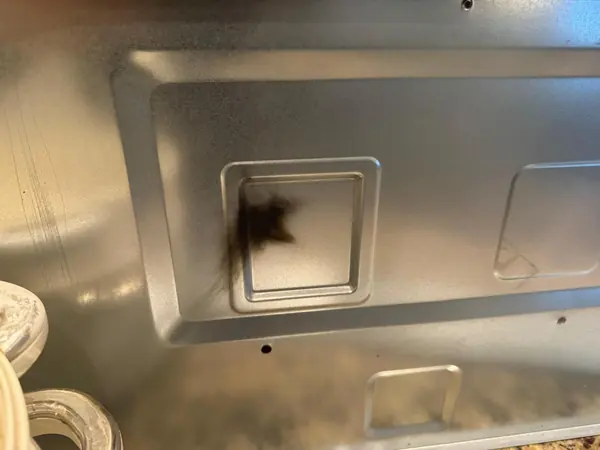
Stop using the microwave and call for service if you see sparks or arcing with nothing metal inside, smell burning, notice a damaged door or hinge, keep tripping the breaker, or the oven runs normally but still will not heat after the checks above. Each of those points to the high-voltage section, the interlocks or the control board.
Example: Say an over-the-range microwave runs and the turntable spins, but food comes out cold. Checking that the door shuts fully and that Demo mode is off takes two minutes and solves some of these cases. If neither is the cause, the fault is in the high-voltage circuit or the door interlocks, which is a technician's job, and the repair quote can then be weighed against the full installed cost of a new unit.
Should you repair or replace a microwave?
The answer depends heavily on the type. A useful rule from our repair-or-replace guide applies: when a repair approaches half the cost of a comparable new unit and the appliance is past the middle of its life, replacement deserves a serious look.
| Type | Repair usually makes sense when | Replacement usually makes sense when |
|---|---|---|
| Countertop | It is a higher-end or newer model, or still under the manufacturer's warranty | It is a basic model, since a new one often costs about as much as a repair |
| Over-the-range | The fault is a single part, and the unit matches your other appliances | Several parts have failed, or the unit is old and parts are hard to find |
| Built-in, drawer or wall-oven combination | Almost always worth pricing first, since replacements must fit the existing cabinet cutout | Parts are discontinued or the repair approaches the cost of a new unit |
Over-the-range models deserve extra thought because replacing one is not a simple swap. The old unit has to come down, the new unit's mounting plate has to be fastened to the wall studs and lined up with the cabinet above, the venting has to be set up for outside or recirculating air, and the job usually takes two people. If you go that route, plan for professional appliance installation in the total cost.
Before paying for any repair, check whether the unit is still under the manufacturer's warranty. For out-of-warranty units, Appliance Surgeon's diagnostic visit is $75, credited toward the repair if you approve the written quote. Learn more about microwave repair, or compare typical prices in our appliance repair cost guide.
Sources
- cpsc.gov: CPSC Publication 5061: warning against DIY microwave repair, shock possible after unplugging, failed internal devices can injure even when unplugged, average of two electrocution deaths a year in 2006–2008, professional repair recommended
- whirlpool.com: Whirlpool over-the-range microwave tech sheet (technician use only): high voltage at magnetron and high-voltage capacitor terminals; discharge capacitor before accessing components
- manualslib.com: GE JVM1750 technical service manual: capacitor has an internal resistor to discharge automatically; technicians must verify it is discharged before servicing
- fda.gov: FDA regulation since 1971; 21 CFR 1030.10 leakage limit of 5 mW/cm² at about 2 inches; two independent interlocks; do not use an oven with a damaged door; contact manufacturer about damaged hinges, latches or seals
- hps.org: magnetron produces the microwaves; interlock de-energizes the magnetron when the door opens
- producthelp.whirlpool.com: check outlet and breaker, plug directly into a wall outlet, close door firmly, Control Lock and Demo mode off
- producthelp.whirlpool.com: test outlet with another appliance, breaker reset for one minute
- producthelp.whirlpool.com: turntable right side up and seated on support; do not operate without turntable
- samsung.com: Demo mode works but does not heat, timer counts down faster; door not fully shut may run without heating
- products.geappliances.com: GE child lockout: press and hold Clear/Off or Pause/Off about 3 seconds