No ice at all
The ice maker is switched off or its arm is raised, the freezer is too warm, the water valve is closed, or the fill tube has frozen shut. When all of those check out, the inlet valve or the ice maker module has usually failed.
Appliance Surgeon repairs the ice makers built into refrigerators and freezers, from side-by-side door dispensers and French-door ice rooms to built-in Sub-Zero units, and residential undercounter ice makers as well. We find why the ice stopped, quote before any work begins and test the water fill and the dispenser before we leave.
Schedule ice maker repair
Monday - Friday: 8 AM to 10 PM
Saturday: 8 AM to 10 PM
Sunday: 10 AM to 10 PM
Diagnostic visit: $75, or $115 for a double unit.
Credited toward your repair when you approve the quote.
The symptom narrows the search. These are the patterns our technicians see most, and where they look first.
The ice maker is switched off or its arm is raised, the freezer is too warm, the water valve is closed, or the fill tube has frozen shut. When all of those check out, the inlet valve or the ice maker module has usually failed.
Not enough water reaches the mold. An old filter, a partly closed supply valve, a kinked line or a clogged saddle valve starves the inlet valve, and a fill tube that is starting to freeze does the same.
Cubes melt and refreeze when warm air gets in: a freezer door that no longer seals, a gap around a French-door ice room, or a power outage. A valve that drips between cycles can also glue the bin into one block.
The bin is full but the door chute stays empty. That points to a jammed bucket, the auger motor that pushes ice forward, the flap or its solenoid in the chute, or the dispenser switch.
Water in the bin, on the shelf below or on the floor usually comes from a fill tube that has shifted, a valve that seeps, a cracked supply line or, on French-door models, a frozen ice room drain.
An ice maker that keeps calling for water it never gets makes the valve buzz or the module click. Check the supply first; if the water is on and the noise goes on, the valve or the module is at fault.
Switch and arm. Make sure the ice maker is on at the control panel, or that its wire arm or paddle is down. A bag of store-bought ice pushed into the bin can hold the arm up and stop production.
Freezer temperature. Leave a thermometer in the freezer for a few hours. It should read about 0°F. Most ice makers only cycle when the mold is well below freezing, so a freezer near 10°F or warmer makes little or no ice, and the real repair is the cooling.
Filter and supply. Replace a filter older than about six months and run a few glasses of water through it. Follow the line back to its valve, under the sink or behind the refrigerator, and make sure the valve is open and the tubing is not crushed behind the unit.
Frozen fill tube. If ice has formed where the water enters the back of the ice maker, do not chip at it with a knife or screwdriver. Switch the ice maker off, let it thaw and tell us, because a tube that freezes once usually freezes again until its cause is found.
Codes and resets. Write down any code or blinking light before you reset anything. Reset steps differ by brand: our GE ice maker guide covers GE, and the ice maker troubleshooting guide walks through the general checks.
Side-by-side refrigerators. The ice maker sits at the top of the freezer and drops cubes into a bin with an auger that feeds the door chute. Jammed bins, auger motors and chute flaps are the usual repairs.
French-door refrigerators. Many Samsung, LG and Whirlpool models make ice in a compartment on the fresh-food door, chilled by air ducted up from the freezer. When that compartment leaks air, frost builds, cubes clump and water can drip into the fridge. Repairs range from a new ice maker to resealing the compartment.
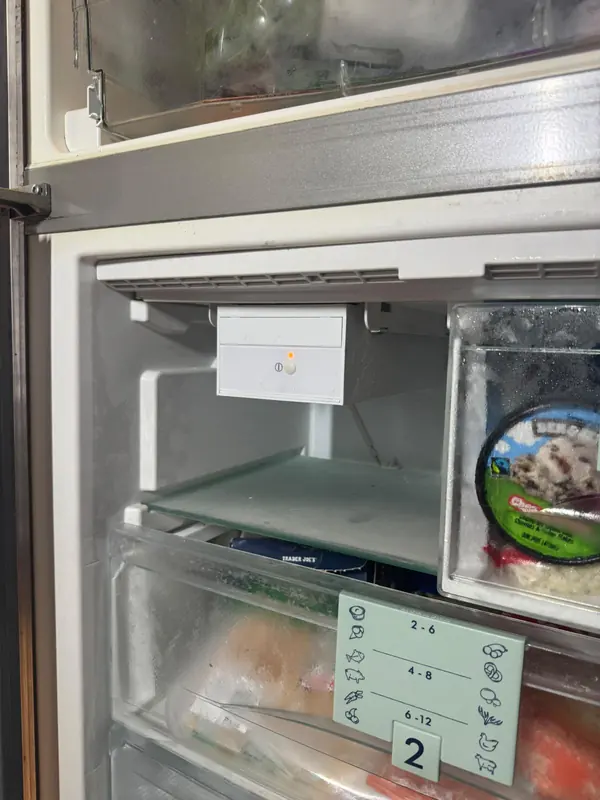
Bottom-freezer and top-freezer models. The ice maker is mounted inside the freezer itself, like the one in the photo below, with a bin underneath and no door dispenser to go wrong.
Built-in refrigerators. Sub-Zero, Thermador, Viking and other built-ins use heated fill tubes and modular ice makers. See our Sub-Zero ice maker notes for that brand’s common faults.
Undercounter ice makers. Freestanding residential units, such as Scotsman cube and nugget machines, have their own water reservoir, level sensors and, on many models, a drain pump. Hard water scales them, so they need cleaning on the maker’s schedule.
We repair ice makers in homes. Commercial ice machines in restaurants, offices and shops are outside our work.
From our job log, newest first. Shared by month and town only.
Samsung French-door: ice stopped dropping into the bucket. We replaced the ice maker unit and cleared a frozen fill tube.
Samsung French-door: the ice maker had frozen into a solid block with the bucket stuck in its housing. We thawed the ice room, closed the air leak around it with the maker’s clip kit and fitted a new ice maker.
LG French-door: the ice maker leaked water into the fresh-food tray. We replaced the fill tube water valve assembly and recalibrated the ice maker.
GE Profile French-door: no ice harvest and a slow water dispenser. The water filter head valve and the secondary water valve were replaced.
GE Profile side-by-side: the bucket had jammed into one frozen mass and nothing dispensed. We replaced the auger motor assembly and thawed the chute passage.
Built-in Sub-Zero: no ice, with the water supply line frozen solid. The fill tube heater kit and the modular ice maker were replaced.
Scotsman undercounter ice maker: no cubes and an overflowing reservoir. We replaced the failed water level sensor and cleaned mineral scale off the curtain switch.
Ice maker requests from our booking form, newest first, by month and town.
A 2021 Samsung French-door stopped making ice, and the reset procedure had not helped.
The water line in a Kenmore’s ice compartment kept freezing. After it thawed, melted ice refroze around the auger that feeds the dispenser.
A Scotsman nugget ice maker ran its drain for long stretches, sometimes without stopping.
An Electrolux refrigerator’s ice maker quit, and the owner offered a window that same day.
A Frigidaire side-by-side still made ice but would not send it through the door.
The plastic ice level arm on a built-in Sub-Zero broke, so ice production stopped and the drawer stuck open.
Every visit starts with the $75 diagnostic, or $115 for a double unit, and that fee is credited toward the repair when you approve the quote.
Labor starts at $200 and stays there on about 9 in 10 repairs; complex jobs can reach $450 in labor. Parts are extra and are listed on the quote. Every repair carries a 90-day parts-and-labor warranty.
Repair or replace. An ice maker module is usually replaced as one assembly, and often that is the whole job. When the module failed because of something else, such as a seeping valve, a warm freezer or an ice room that leaks air, we fix that too, or the new module freezes up the same way. If the refrigerator is old and its cooling is also failing, the repair-or-replace calculator is a quick first check.
For cooling, frost and leak problems beyond the ice maker, see refrigerator repair and freezer repair.
Once the freezer is cold and water reaches the mold, the first cubes usually drop within a few hours. A full bin takes about a day of normal running. Throw out the first batch after a new filter, valve or ice maker.
The common sources are a fill tube that has shifted away from the mold, an inlet valve that seeps between cycles and a cracked supply line. On French-door models with an ice room in the door, a frozen drain or a gap in the compartment’s seal can send water into the fresh-food section.
Yes. Built-ins from Sub-Zero, Thermador, Viking and similar brands use modular ice makers and heated fill tubes, and we repair both. In McLean we replaced a Sub-Zero’s fill tube heater kit and ice maker after its supply line froze.
Yes, residential undercounter units such as Scotsman cube and nugget machines. They have their own water level sensors, parts that scale up in hard water and, on many models, a drain pump. Commercial ice machines are outside our work.
Yes. Switch it off or raise the arm, so the ice maker stops calling for water that never arrives. Left on, it can keep the water valve buzzing.
Often, when the refrigerator still cools well, because the repair is usually limited to the ice maker, a valve or a dispenser part. If the cooling is failing too, we price both so you can decide with the full picture.
These guides explain the most common symptoms, which checks are safe to try yourself, and when a technician should take over. All guides.
Ice maker not making ice? Check the shutoff arm, freezer temperature, water filter and supply line, and learn which failures need a repair visit.
GE ice maker stopped making ice? Find the power switch and feeler arm, replace the filter, thaw the fill tube and learn which GE failures need a repair visit.
Water inside the fridge or pooling underneath? Trace it to the defrost drain, water line, drain pan or filter housing with this cause-by-cause repair guide.
Heavy frost in the freezer usually points to a door seal leak, blocked vents or a failed defrost part. Learn the causes, the safe fixes and when to book repair.