A Maytag dryer ran but did not heat.
What our technicians usually find: on electric models, the heating element, a thermal fuse or the high-limit thermostat; on gas models, the igniter or gas valve coils.
Dryer not heating after you cleared the lint, not starting, or taking forever? We repair gas and electric dryers in McLean and check the vent on every no-heat call.
Appliance Surgeon offers same-day and next-day visits to McLean homes and buildings. The $75 diagnostic visit is credited to the repair, labor starts at $200 on about 9 in 10 repairs, and every repair carries a 90-day parts-and-labor warranty.
Schedule service in McLean
Same-day and next-day visits.
Open 7 days until 10 PM (Sundays from 10 AM)
Diagnostic visit: $75, or $115 for a double unit.
Credited toward your repair when you approve the quote.
90-day warranty on parts and labor, and a written quote before any work starts.
Newer McLean houses tend to put laundry on the bedroom floor, and that often means a long dryer vent through the ceiling or out the roof. Long runs gather lint and make the dryer run hot. Heat is what opens a thermal fuse, so if yours blew one, the vent gets checked as well, or the replacement fuse tends to go the same way.
A Maytag request from McLean in November 2025 was for a dryer that had stopped heating. On an electric dryer the usual causes are the heating element, the thermal fuse or the high-limit thermostat, and on gas, the igniter or the gas-valve coils. Two nearby requests in the cards below follow the same lines: a Kenmore in Clarendon that stayed cold after the lint was cleared and the power reset, and a Maytag in Great Falls that stopped working altogether, which points to a thermal fuse, the door or start switch, the belt or the motor.
Noise usually comes from the parts that carry the drum. In November 2024 in Franklin Park, the drum of an Electrolux electric dryer let out a loud metallic squeal as it turned, and it needed a new rear drum bearing and belt idler. Rollers, glides and idler pulleys wear the same way, and replacing them early costs less than waiting for the belt to snap.
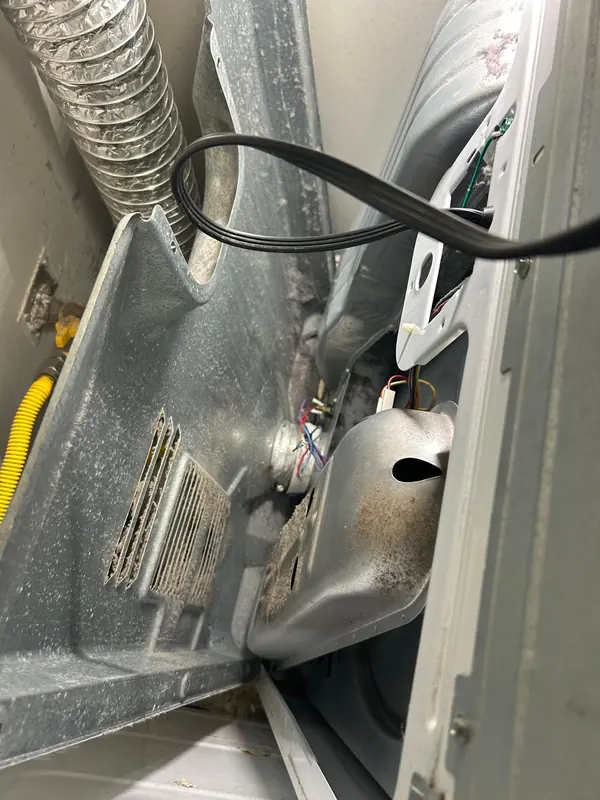
On a no-heat call, the technician measures temperature and airflow inside the drum first, looks at the vent where it can be reached, then tests the fuse, thermostats and element. You can check the vent yourself: with the dryer on high, go outside and feel the air leaving the vent hood. Strong, warm air is good, and weak air means the duct needs cleaning. A roof vent can pack with lint under the cap without anyone noticing.
Elements, fuses, thermostats, belts, rollers and idlers are worth fixing on most dryers. A failed drum bearing on an older machine is a closer call, and typical prices are in our repair cost guide if you want to compare.
When you book, give the brand and the model number from the label just inside the door opening, and say whether the dryer is gas or electric and where the vent exits. For a McLean house on a gated drive, add the code. If you smell gas near a gas dryer, don't touch it or any switch. Get out of the house first, then call Washington Gas or 911.
Updated November 2026.
A Maytag dryer ran but did not heat.
What our technicians usually find: on electric models, the heating element, a thermal fuse or the high-limit thermostat; on gas models, the igniter or gas valve coils.
The drum of an Electrolux electric dryer turned with a loud metallic squeal.
Repair: Replaced the rear drum bearing and the belt idler.
From our technicians’ service log and online repair requests; customer details are kept private. A request shows what the customer reported; the technician confirms the cause on site before quoting.
A Maytag dryer stopped working.
What our technicians usually find: a blown thermal fuse, the door switch, the start switch, a broken belt or the motor.
A Kenmore dryer stopped heating even after the lint was cleared and the power reset.
What our technicians usually find: a heating element, thermal fuse or high-limit thermostat; on gas dryers, the igniter or gas valve coils.
Dryer repair in ArlingtonCompany data; customer details are kept private. “What our technicians usually find” is the common cause of that problem, confirmed by our team. The technician confirms the cause on site before quoting.
The checklist our technicians follow on every visit is on the Dryer Repair page.
Seeing an error code on the display? Look it up: LG dryer, Samsung dryer, Whirlpool dryer, GE dryer, Bosch dryer, Miele dryer, or browse all error codes.
Before you book in McLean, VA, these guides explain the most common symptoms, which checks are safe to try yourself, and when a technician should take over. All guides.
Every appliance we repair in McLean is on one page: appliance repair in McLean, VA. You can also go straight to refrigerator repair, freezer repair, washer repair, dishwasher repair, oven repair, stove and range repair, cooktop repair, microwave repair, range hood repair, wine cooler repair or HVAC repair, all in McLean.
We also provide dryer repair in Tysons, VA, dryer repair in Falls Church, VA, dryer repair in Vienna, VA, dryer repair in Arlington, VA and dryer repair in Bethesda, MD.
This location is part of our dryer repair coverage across the DC metro area. See all appliance repair services in McLean, VA.
Neighborhoods we regularly cover in McLean, VA: Langley, Chesterbrook and Lewinsville.
We're based in Alexandria, about 11 miles from McLean. Same-day and next-day appointments are available when the technician route has open windows; call or book online for the earliest option. Appointments cost the same on weekdays, evenings and weekends - our hours run 8 AM to 10 PM Monday through Saturday and 10 AM to 10 PM on Sunday, all at one standard rate.
Many dryer repairs are completed in a single visit once the technician has diagnosed the fault and confirmed the parts on hand. If a specific part has to be ordered, we schedule a short return visit to finish the job.
Appliance Surgeon charges $75 for the diagnostic visit, or $115 for a double unit (such as a double wall oven, washer-dryer combo or stacked laundry), and the fee is credited toward the repair if you approve the quote. Labor starts at $200 and stays there on about 9 in 10 repairs; more complex jobs can reach $450. Parts are extra and listed in the quote. Heating elements, igniters, thermal fuses and rollers are the common, reasonably priced fixes. The quote comes after diagnosis and before repair - and if restricted airflow is what is really shortening your dryer's life, we say so instead of selling the next part. Typical price ranges by appliance are in our appliance repair cost guide.
Common calls include dryer not heating, long drying times, dryer squeaking, drum not turning, burning smell and airflow restriction. The exact cause is confirmed during diagnosis.
Then a part has probably failed: the heating element, thermal fuse or high-limit thermostat on an electric dryer, or the igniter or gas-valve coils on gas. A blown thermal fuse usually means the vent was restricted, so we check that too.
Usually. Roof vents are long, and lint can pack in under the roof cap without anyone noticing. Check the airflow outside while the dryer runs. If it's weak, have the duct cleaned before anything else.
Start with the safe basics: empty the lint screen, confirm the breaker has not tripped, and check that the outside vent flap opens freely. Leave heating elements, thermostats and gas components to a technician - and if you ever smell burning, stop using the dryer until it is inspected.
Use it as little as possible until it is checked. A squeal or metallic grind usually comes from a worn drum bearing, an idler pulley or the drum rollers, and a thump often means a flat spot on a roller or a loose baffle. Running it longer can wear the shaft or break the belt, which adds to the repair. An Electrolux in Franklin Park needed a rear drum bearing and idler for this kind of squeal in November 2024.
Run the dryer on high and check the air at the outside vent. Weak or barely warm air, loads that need a second cycle, a dryer that feels hot on top, or a thermal fuse that has blown before all point to a restricted duct. Upstairs laundry rooms often vent through the ceiling or roof, and those long runs collect lint at the bends and under the cap. Have the duct cleaned, then book a repair if drying stays slow.