Dryer Tumbling But Not Heating? Here Are the Top 4 Causes
A dryer that tumbles but will not heat usually has one of four problems: a power or gas supply fault, a blown thermal safety part, a failed heat source, or a bad cycling thermostat or temperature sensor. On an electric dryer, check the breaker first, because the drum can turn on half of its 240-volt supply while the heater gets nothing; on a gas dryer, check that the gas shutoff valve is open.
The motor and the heat source are on separate circuits, which is why the drum can spin normally while the clothes stay cold. Below are the four causes in the order a technician usually rules them out, how they differ between electric and gas models, and the venting problem behind many of these failures.
First, rule out the cycle setting
Before you look for a broken part, confirm the dryer is set to a heated cycle. Whirlpool notes that its Air Only and Air/Fluff cycles add no heat at any point, and GE advises using a dry cycle rather than fluff or cool down. A fluff setting left on by mistake looks exactly like a failed heater.
How do electric and gas dryers heat differently?
An electric dryer heats with a 240-volt heating element. Whirlpool specifies a separate 30-amp circuit fused on both sides of the line, which means two breakers (normally a double-pole breaker) feed the dryer. A gas dryer heats with a burner lit by an igniter, and GE notes it runs on a dedicated 120-volt outlet.
Both types share the same family of safety controls. The U.S. Consumer Product Safety Commission (CPSC) describes an operating thermostat that turns the heat off at a set temperature, a high-limit thermostat that shuts the heat off if the heater area runs too hot, and a thermal fuse or thermal cut-off that opens at a preset temperature and must then be replaced.
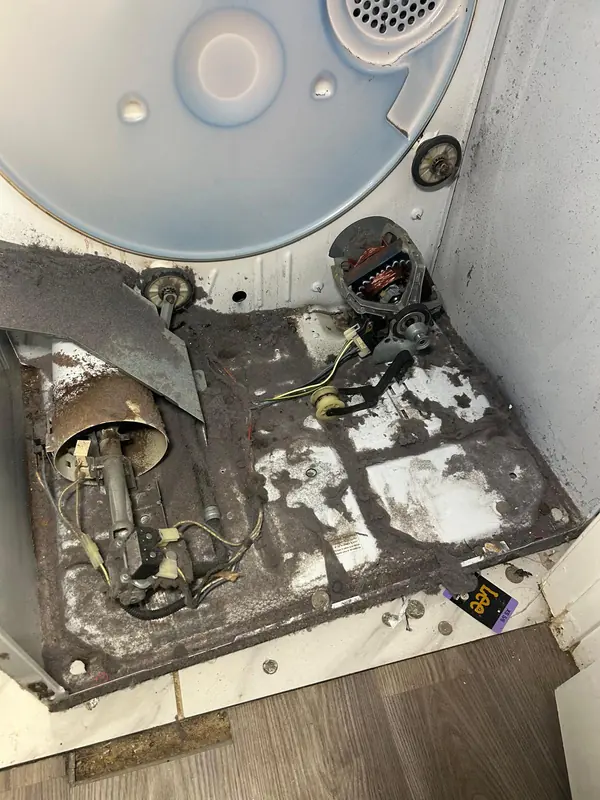
The top 4 causes
1. Power or gas supply problem
On electric dryers, one side of the 240-volt supply can be lost while the other side still runs the motor. GE explains that an electric dryer may run on partial 120-volt power but will not heat without its full 208/240-volt supply, and that a breaker can be partially tripped even when it does not look tripped. A blown fuse in an older fuse panel or a loose connection at the power cord causes the same symptom. Switch the breaker fully off, then back on, and leave cord and terminal work to a technician.
On gas dryers, Whirlpool notes that the drum will turn but the dryer will not heat if the gas shutoff valve is closed. The valve is open when its handle is parallel to the gas pipe. This is common after a move or a new installation.
2. Blown thermal fuse or thermal cut-off (or a failed high-limit thermostat)
These parts exist to stop an overheating dryer. Where they sit in the circuit varies by model. On one Whirlpool electric dryer tech sheet, the thermal fuse is wired in series with the drive motor, so a blown fuse stops the drum entirely, while the thermal cut-off at the heater kills only the heat. The same sheet tells technicians that when the thermal cut-off has opened, they should replace it together with the high-limit thermostat and check for a failed heating element or a blocked or improper exhaust system.
That last instruction is the point to remember. A blown safety part is usually a symptom, not the root problem, and replacing it without fixing the airflow tends to lead to another failure.
3. Failed heat source: element (electric) or igniter, flame sensor or gas valve coils (gas)
An electric heating element is a coil of resistance wire. When the coil breaks, the dryer runs but produces no heat. Gas dryers have three main burner parts: the igniter that lights the gas, the flame sensor that monitors burner heat during ignition, and the gas valve coils that open the valve.
A Whirlpool, Maytag and Kenmore service data sheet lists tests for all three. It states that if the igniter stays red hot and the gas does not ignite, the flame sensor needs replacing, and if the igniter never glows, it points to missing voltage at the burner, which can trace back to an open safety device or the motor's centrifugal switch. Separately, an igniter that glows, shuts off and never lights the gas, or a dryer that heats at first and then won't relight, usually points to weak gas valve coils.
4. Faulty cycling thermostat or thermistor
The cycling (operating) thermostat, or on many newer dryers an exhaust thermistor read by the control board, tells the dryer when to switch heat on and off. A thermostat that fails open keeps the heat circuit off, while one that opens too early causes weak heat and long drying times. Electronic models often show a fault code when the thermistor reads out of range; a Whirlpool and Maytag service manual describes a code for an exhaust thermistor that reads open or shorted.
Symptom-to-cause table
| What you see | Most likely cause | Dryer type |
|---|---|---|
| Drum turns, no heat on any heated cycle | Lost half of the 240-volt supply (breaker, fuse or cord connection) | Electric |
| Drum turns, no heat right after a move or install | Gas shutoff valve closed | Gas |
| Dryer was drying slower for weeks, then lost heat | Thermal cut-off or fuse blown by a restricted vent | Both |
| Dryer will not start at all | Thermal fuse in the motor circuit on some models, door switch or power | Both |
| Power confirmed, safeties intact, still cold | Open heating element | Electric |
| Igniter stays red hot, no flame | Flame sensor | Gas |
| Igniter glows, goes out, no flame | Gas valve coils | Gas |
| Igniter never glows | Igniter, a flame sensor stuck open, or no voltage at the burner | Gas |
| Heats at first, then goes cold | Gas valve coils | Gas |
| Weak heat, long dry times, or a fault code | Cycling thermostat or thermistor | Both |
Why a restricted vent keeps blowing fuses
When lint builds up in the lint screen, the duct or the outside hood, hot air cannot leave fast enough. In CPSC testing, as lint accumulated, temperatures at the heat source and in the drum rose while the exhaust temperature fell. The safety controls are designed to trip in exactly that condition.
So when a fuse or cut-off blows, check the whole exhaust path: the lint screen, the transition duct behind the dryer (crushed or kinked foil duct is a frequent offender), the duct run and the outside flap, which should open when the dryer runs. CPSC recommends replacing plastic or foil accordion duct with rigid or semi-rigid metal duct. Our post on the hidden dangers of a clogged dryer vent covers the fire risk and cleaning schedule, and why a dryer takes too long to dry covers the slow-drying stage that often comes first.
Example: Say an electric dryer has needed two cycles to dry towels for a month, and now it tumbles with no heat at all. The thermal cut-off turns out to be open, and the foil transition duct behind the dryer is crushed. Replacing the cut-off alone would likely fail again; replacing it together with the high-limit thermostat, as the manufacturer's tech sheet directs, and swapping the foil duct for metal fixes the cause.
What you can safely check, and when to stop
Safe homeowner checks are the cycle setting, the breaker, the gas valve position, the lint screen and the outside vent flap. Unplug the dryer or switch off its breaker, and turn off the gas valve on gas models, before you move the dryer or look behind it.
Stop and call a technician if:
- You smell gas. Washington Gas advises leaving the area, avoiding light switches and phones inside, and calling 911 and its leak line from a safe location.
- The breaker trips again after you reset it.
- You see burnt or loose wiring at the cord's terminal block.
- A thermal fuse or cut-off has blown, because the cause needs to be found, not just the part.
- The problem is in the gas burner. Igniter, flame sensor and valve work belongs to a professional.
If you need a diagnosis, Appliance Surgeon's dryer repair visit is $75 for a single appliance or $115 for stacked laundry, credited toward the repair if you approve the written quote. Typical dryer repair ranges are in our appliance repair cost guide.
Sources
- producthelp.whirlpool.com: Whirlpool: Air Only/Air Fluff cycles add no heat; electric dryers need a 240 V, 30-amp circuit fused on both sides (two breakers); closed gas shutoff valve lets the drum turn without heat; valve open when handle is parallel to the pipe
- products.geappliances.com: GE: electric dryer may run on partial 120 V but will not heat without 208/240 V; breaker can be partially tripped without looking tripped; use a dry cycle, not fluff or cool down; check terminal block for burnt or loose connections
- products.geappliances.com: GE: gas dryer runs on a dedicated 120 V outlet; make sure the gas line is turned on for new installations
- cpsc.gov: CPSC Report on Electric and Gas Clothes Dryers (1999): roles of operating thermostat, high-limit thermostat, thermal fuse and thermal cut-off; as lint accumulated, heat-source and drum temperatures rose while exhaust temperature fell
- whirlpool.com: Whirlpool electric dryer tech sheet: thermal fuse wired in series with drive motor; if thermal cut-off is open, replace it and the high-limit thermostat and check for failed heat element or blocked/improper exhaust
- maytag.com: Whirlpool/Maytag/Kenmore service data sheet: gas valve coil, igniter and flame sensor tests; igniter stays red hot without ignition means flame sensor; igniter not coming on means no line voltage at burner, centrifugal switch suspect
- assets.ajmadison.com: Whirlpool/Maytag L-98 dryer service manual: exhaust thermistor open/shorted fault; igniter, flame sensor and gas valve coil components
- cpsc.gov: CPSC "Overheated Clothes Dryers Can Cause Fires": replace plastic or foil accordion duct with rigid or semi-rigid metal duct
- washingtongas.com: Washington Gas: if you smell gas, leave, avoid switches and phones, call 911 and the leak line from a safe location
- searspartsdirect.com: a gas dryer that heats at first and then stops heating usually has failing gas valve coils
More guides from our technicians
Dryer Not Turning On? What to Check Before You Call
A completely dead dryer usually has a power, door switch, thermal fuse or start switch problem. The safe order to check them in, and when to stop and call.
Amana Dryer Won't Spin? Belt, Idler and Switch Fixes
Amana dryer hums but the drum won't turn? A snapped belt, tired idler pulley or a belt switch is usually why. Run the hand-spin test and know what to book.
Dryer Squeaking, Thumping or Grinding? What Each Sound Means
A squeal, thump, grind or rattle from the dryer each points at a different part. Match your sound to its cause and learn which noises mean stop now.