More Than Just Lint: The Hidden Dangers of a Clogged Dryer Vent
The biggest hidden danger of a clogged dryer vent is fire: the U.S. Fire Administration (USFA) reports that failure to clean is the leading factor in home clothes dryer fires, and that dust, fiber and lint are by far the items most often ignited first. A blocked vent also makes the dryer run hotter and longer, and on a gas dryer a restricted or disconnected vent can let exhaust that may contain carbon monoxide leak into the house.
The good news is that this is one of the most preventable hazards in a home. Below is what the fire data says, the warning signs to watch for, how often to clean, which duct material to use and when the job belongs to a professional.
How common are dryer fires?
Several national sources track dryer fires. They use different methods and categories, so their totals differ, but they agree on the leading cause.
| Source | Years covered | Key findings |
|---|---|---|
| USFA, Clothes Dryer Fires in Residential Buildings | 2008–2010 | About 2,900 fires a year, 5 deaths, 100 injuries and $35 million in property loss; failure to clean was the leading factor (34%); dust, fiber and lint were the first item ignited in 28% |
| NFPA fact sheet, Home Fires Involving Clothes Dryers and Washing Machines | 2010–2014 | About 15,970 home fires a year involving dryers or washers, 92% of them involving dryers; 13 deaths, 440 injuries and $238 million in direct damage; failure to clean was the leading cause (31%) |
| USFA, Appliance and Electrical Fire Safety | 2018–2020 | Failure to clean (31%) was the leading factor in home clothes dryer fires |
The USFA's 2008–2010 report also found that January had the most dryer fires, with higher numbers through fall and winter, when dryers run more often.
Why does a clogged vent start fires?
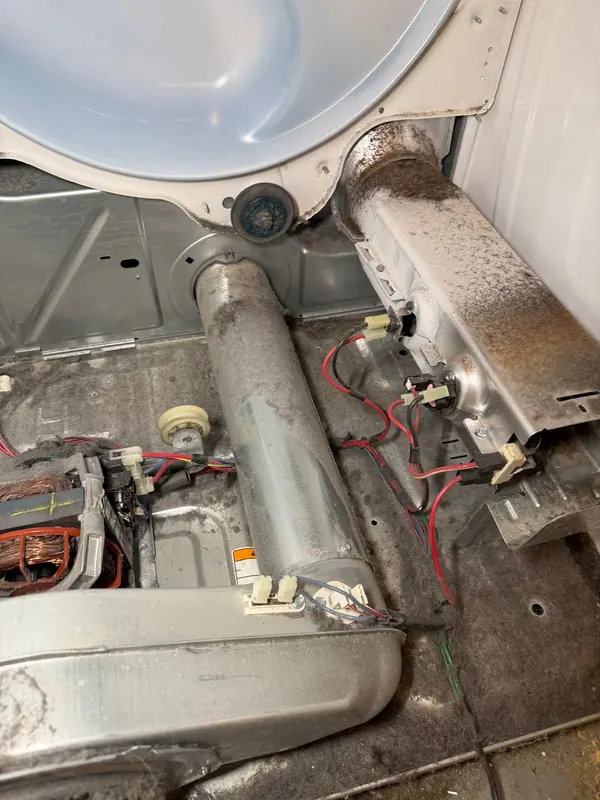
A dryer has to push hot, moist air and fine lint out of the house. The lint screen catches most of the lint, but some always passes into the duct, and it collects at bends, low spots, crushed sections and the outside hood.
As that buildup narrows the path, heat stays inside the machine. In testing described in a 1999 report by the U.S. Consumer Product Safety Commission (CPSC), as lint accumulated, temperatures at the heat source and in the drum gradually rose while the exhaust temperature fell. That is the condition in which lint and clothing can ignite, and it is also why the dryer's thermal safety parts trip. If your dryer has stopped heating, our guide to a dryer tumbling but not heating explains how a clogged vent blows those parts.
What are the warning signs of a clogged dryer vent?
Watch for these signs:
- Clothes are still damp after a normal cycle, or drying takes longer than it used to. CPSC lists both as signs that the lint screen or exhaust duct may be blocked.
- The outside vent flap does not open while the dryer runs. USFA advises checking that the outdoor vent covering opens during operation.
- Little or no air comes out of the outside hood while the dryer is running.
- The duct behind the dryer is crushed, kinked, torn or disconnected.
- Lint is collecting behind or under the dryer, or around the outside hood.
- The dryer or laundry room feels hotter than usual, or you notice a hot or burning smell. Stop using the dryer if you smell burning.
- Your dryer shows a "Check Vent" light. Some Whirlpool and Maytag models have this indicator, which shows the status of airflow through the dryer and vent system.
Slow drying is the earliest sign and the easiest to miss. Our post on why a dryer takes too long to dry covers the other causes, so you can tell a vent problem from a dryer fault.
How often should you clean a dryer vent?
The National Fire Protection Association (NFPA) recommends cleaning lint out of the vent pipe once a year, or more often if drying is taking longer than normal. Clean the lint filter before or after every load, and never run the dryer without it.
| Task | How often | Source |
|---|---|---|
| Clean the lint filter | Every load | NFPA, USFA |
| Clean behind and under the dryer | When lint builds up | USFA |
| Clean lint out of the vent duct | At least once a year, sooner if drying slows | NFPA |
| Check that the outside flap opens and air flows | Periodically, with the dryer running | USFA, CPSC |
| Have a gas dryer's gas line and connection inspected | By a qualified professional | NFPA |
Which dryer vent material is safest?
CPSC recommends replacing plastic or foil accordion-type duct with rigid or corrugated semi-rigid metal duct. Rigid and semi-rigid metal provide the most airflow, while flexible plastic or foil traps lint more easily and kinks or crushes more readily. NFPA likewise says rigid or flexible metal venting should be used.
Building codes go further. The International Residential Code, a model code many jurisdictions adopt with local changes, sets these limits in its 2021 edition (Section M1502):
- The exhaust duct must be smooth-walled metal at least 0.0157 inch thick and 4 inches in diameter.
- Joints must not use screws that stick more than 1/8 inch into the duct, where they catch lint.
- The flexible transition duct behind the dryer must be listed to UL 2158A, no longer than 8 feet and never hidden inside a wall or ceiling.
- The run is limited to 35 feet, reduced for each elbow, unless the dryer maker's installation instructions set a different length.
- The outside termination needs a backdraft damper, and screens are not allowed there because they trap lint.
Codes vary by jurisdiction and year, so check with your local building department before changing a vent run.
Do gas dryers add a carbon monoxide risk?
Yes, if the venting is poor. Gas dryers burn natural gas or propane, and the vent carries combustion by-products outdoors along with moisture. Technical Safety BC, a Canadian safety regulator, warns that restrictions in a gas dryer's vent may cause exhaust that could contain carbon monoxide (CO) to leak. CPSC lists malfunctioning fuel-burning appliances as a source of CO in the home and recommends CO alarms on every level and outside sleeping areas.
Early CO symptoms include headache, fatigue, shortness of breath, nausea and dizziness. If a CO alarm sounds, CPSC advises going outside to fresh air right away and calling 911. If you smell gas, Washington Gas advises leaving the area, avoiding light switches and phones inside, and calling 911 and its leak line from a safe place.
Example: Say a second-floor dryer vents through a long duct with several bends up to the roof, and loads that used to dry in one cycle now take two. Lint collects at bends and at the outside hood, and a roof termination is hard to reach safely from the ground. That is a vent for a professional to clean, and if drying is still slow afterward, the dryer itself should be checked.
When should you call a professional?
Cleaning the lint filter, the area behind the dryer and a short, straight, reachable duct is a reasonable homeowner job. Unplug the dryer first, and on a gas dryer turn off the gas valve and take care not to strain the gas connector when you move the machine. Call a professional when:
- The duct is long, has several bends, or ends on the roof or a high wall.
- The duct runs through walls, ceilings or an attic where you cannot see it.
- You find plastic or foil duct that needs replacing with metal.
- Drying is still slow after cleaning, which can point to a fault inside the dryer.
- You smell burning, smell gas, or a CO alarm has sounded.
If the vent is clear and the dryer still runs slow or hot, Appliance Surgeon can diagnose it through our dryer repair service; the $75 diagnostic visit is credited toward the repair if you approve the quote.
Sources
- usfa.fema.gov: USFA Topical Fire Report, Clothes Dryer Fires in Residential Buildings (2008–2010): 2,900 fires, 5 deaths, 100 injuries, $35 million a year; failure to clean 34%; dust, fiber and lint first ignited 28%; January peak (11%)
- usfa.fema.gov: USFA: failure to clean (31%) leading factor in home clothes dryer fires, 2018–2020
- usfa.fema.gov: USFA flyer: clean lint filter before and after each cycle; do not use without a filter; clean the back of the dryer; check venting is not damaged, crushed or restricted; make sure the outdoor vent covering opens
- cityofsemmesal.gov: NFPA fact sheet (Campbell, April 2017, copy hosted by City of Semmes, AL): 2010–2014 average of 15,970 home fires involving dryers or washers, 13 deaths, 440 injuries, $238 million; 92% involve dryers; failure to clean leading cause (31%)
- michigan.gov: NFPA clothes dryer safety tip sheet (copy hosted by State of Michigan): failure to clean is the leading cause; clean vent pipe once a year or more often; rigid or flexible metal venting; gas dryers inspected by a qualified professional
- cpsc.gov: CPSC "Overheated Clothes Dryers Can Cause Fires": damp clothes or longer drying as a sign of blockage; replace plastic or foil accordion duct with rigid or semi-rigid metal; check outside vent while operating
- cpsc.gov: CPSC Report on Electric and Gas Clothes Dryers (1999): as lint accumulated, heat-source and drum temperatures rose while exhaust temperature fell
- seattle.gov: 2018 Seattle Residential Code Chapter 15 (based on the 2018 IRC), Section M1502: duct material and size, screw protrusion, UL 2158A transition duct max 8 ft and not concealed, 35 ft maximum length with fitting reductions or per manufacturer, backdraft damper and no screens at termination
- assets.ajmadison.com: Whirlpool/Maytag dryer service manual: Check Vent indicator shows airflow status through the dryer and vent system
- technicalsafetybc.ca: Technical Safety BC: improper venting poses a CO risk on gas dryers; vent restrictions may cause leaks of exhaust that could contain CO
- cpsc.gov: CPSC: malfunctioning fuel-burning appliances as CO sources; CO alarms on every level and outside sleeping areas; symptoms; if the alarm sounds, go outside and call 911
- washingtongas.com: Washington Gas: what to do if you smell gas
- dryerbox.com: 2021 IRC Section M1502 (excerpt hosted by a vent-box maker): same five duct rules; length limit renumbered M1502.4.6.1
More guides from our technicians
Dryer Not Turning On? What to Check Before You Call
A completely dead dryer usually has a power, door switch, thermal fuse or start switch problem. The safe order to check them in, and when to stop and call.
Amana Dryer Won't Spin? Belt, Idler and Switch Fixes
Amana dryer hums but the drum won't turn? A snapped belt, tired idler pulley or a belt switch is usually why. Run the hand-spin test and know what to book.
Dryer Squeaking, Thumping or Grinding? What Each Sound Means
A squeal, thump, grind or rattle from the dryer each points at a different part. Match your sound to its cause and learn which noises mean stop now.